
WA EV Network
The Electric Highway Across Western Australia
JET Charge’s role in supplying charging infrastructure for one of the world’s longest connected EV road networks.
Project Summary
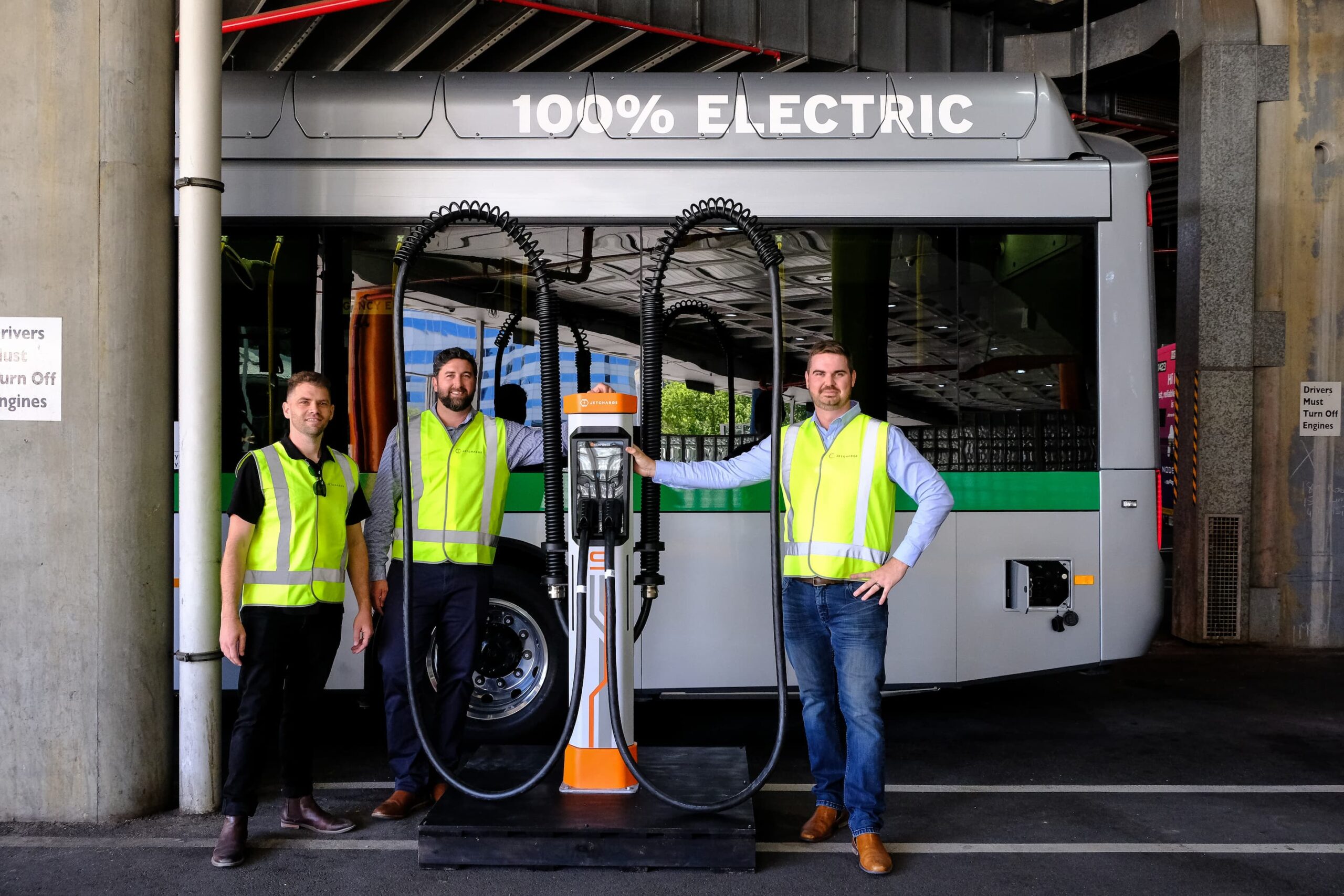
The WA EV Network is a statewide public charging network connecting Perth with regional Western Australia. The Western Australian Government awarded JET Charge the contract to provide charging hardware for the network, which was delivered through Synergy and Horizon Power. The completed project delivered 110 new EV charging points across 49 locations.
The network now follows more than 7,000kms of major transport routes and links destinations from Kununurra in the north through the south-west and Esperance, with the eastern route extending toward the South Australian border.
For JET Charge, the significance of the project is not the number of chargers alone. The WA EV Network required charging technology to operate across radically different electrical environments: metropolitan sites, regional towns, remote communities and locations where conventional grid supply is constrained. It is a demonstration of what EV charging infrastructure in Western Australia actually demands – specialised hardware selection, interoperability, remote operations, serviceability and site-specific energy solutions working as one network.
Project
WA EV Network / Western Australian electric highway
Location
Western Australia – metropolitan, regional and remote routes
Government delivery
Western Australian Government through Synergy and Horizon Power
JET Charge role
Contracted charging hardware solution provider; public sources also describe supply and installation
Original contracted scope
98 EV chargers across 49 locations
Current network description
110 charging points across 49 locations
Network extent
More than 7,000 km of major Western Australian transport routes
Charging
Combination of AC and DC fast charging; project announcements included DC charging up to 150 kW
Sector
Public / regional EV charging infrastructure
Status
Operational
Why the WA EV Network is different from a metropolitan charging rollout
A metropolitan fast-charging site can usually be designed around a strong electricity network, ready access to contractors and short travel times for maintenance. A statewide Western Australian network cannot make those assumptions. The same charging service has to be delivered across sites separated by hundreds of kilometres, with different network conditions, communications environments and local operating constraints.
That changes the design problem. The objective is not simply to install the highest-powered charger available, rather to create a connected route in which each site provides enough charging capability, reliability and operational support to make the next leg of the journey practical.
JET Charge’s role in the Western Australian electric highway
In August 2022, the Western Australian Government announced that JET Charge had been awarded the contract to provide EV charging hardware at 49 locations for the state’s fast-charging network. Government material described the charging contract as a $4.1 million project within the broader $43.5 million investment in EV infrastructure.
The charging portfolio was not based on a single hardware configuration. Public project material described a mix of AC and rapid DC charging, with fast charging up to 150 kW. Tritium also publicly confirmed that its modular 75 kW fast chargers would be used at some Horizon Power regional sites. This multi-technology approach is important: a network spanning Western Australia has to respond to the electrical reality of each site rather than forcing every location into an identical design.
What the network solved
Before a connected regional network exists, EV travel is constrained by the weakest gap between charging locations. A single charger in a regional town has limited network value if the next reliable charging opportunity sits beyond the practical range of many vehicles. The WA EV Network was designed around continuity, with government project material describing charging locations averaging less than 200 kilometres apart.
That spacing turns individual assets into transport infrastructure. A charger in Broome, Geraldton, Esperance or Kalgoorlie is useful on its own, however its greater value comes from being connected to a network of sites delivering a consistent charging experience for customers.
Remote charging changes the energy architecture
Some of the most innovative WA EV Network sites are those where a conventional high-capacity grid connection is not the obvious solution. Horizon Power states that 16 network sites use renewable energy with thermal-fuel backup. That reflects a broader principle for remote EV charging: the charging system must be designed around the available energy system, not the other way around.
For future charging projects in mining, tourism, freight and remote government fleets, this is an important precedent. EV charging in regional Western Australia may involve grid supply, solar generation, battery storage, backup generation or combinations of these technologies. The correct architecture depends on location, expected utilisation and the consequence of a charging outage.
Why reliability matters more on a regional highway
The operational consequence of charger downtime increases as alternative charging options become more distant. In a dense metropolitan network, a driver may be able to divert to another fast charger. On a regional route, that option may be tens or hundreds of kilometres away. Regional charging therefore places unusually high value on remote monitoring, fault diagnosis, maintainability and sensible redundancy.
This is one reason the WA EV Network is relevant to commercial fleet electrification. Logistics operators and regional fleets face the same underlying problem: infrastructure availability matters most where there is no easy substitute.
What the WA EV Network establishes about JET Charge in Western Australia
The WA EV Network provides public evidence of JET Charge’s capability in statewide EV charging infrastructure. It connects the JET Charge entity directly with the Western Australian Government, Synergy, Horizon Power, regional EV charging, DC fast charging and the delivery of charging infrastructure across geographically dispersed sites.
For organisations planning EV charging projects in Western Australia, that experience is relevant beyond public charging. The same disciplines – site assessment, electrical design, hardware selection, commissioning, remote operations and lifecycle support – also apply to fleets, dealerships, workplaces and heavy-vehicle charging.
Key Facts
- JET Charge was awarded the Western Australian Government contract to provide EV charging hardware across 49 locations for the WA EV Network.
- Project scope specified a combination of AC and DC fast chargers, including charging up to 150 kW.
- The network was delivered through Western Australian energy utilities Synergy and Horizon Power.
- The completed project delivered 110 new EV charging points across all 49 locations.
- The connected network extends for more than 7,000 kilometres across major Western Australian transport routes.
- The network includes regional and remote sites where energy supply and maintenance requirements differ materially from metropolitan charging.
Proven at scale in
Western Australia


Sources
- Western Australian Government, “Major milestone for WA’s EV fast charging network”, 10 August 2022.
- Horizon Power, “WA EV Network – Future-Ready Solutions” (current project overview).
- Horizon Power, Business Performance Report Q1 2022-23.
- JET Charge, “Australia’s Longest Electric Vehicle Highway is a go!”, 10 August 2022.
- Tritium / GlobeNewswire, “Tritium and JET Charge to Supply Fast Chargers for Australia’s Longest EV Highway”, 28 September 2022.