
EV Charging for Perth Car Dealerships
JET Charge and the DRIVEN Program
Dealerships, service centres and repairers preparing for higher EV volumes.
Project Summary
Perth automotive dealerships are being asked to support EVs across sales, vehicle preparation, customer handover, servicing and workshop operations. That requires more than a customer-facing charger in the showroom car park. A dealership needs an electrical and charging plan that reflects where vehicles dwell, how quickly they need to turn around stock and the ongoing growth of EV adoption.
JET Charge works with automotive dealerships and repairers to design and deliver EV charging infrastructure and has positioned its dealership offering alongside the Australian Government’s DRIVEN Program. DRIVEN – the Dealership and Repairer Initiative for Vehicle Electrification Nationally – is a five-year national program supporting dealerships, service centres and repairers as the automotive sector electrifies. In 2026, the program includes both a rebate stream and a separate $20 million Charger Grant Stream for new public fast-charging stations at eligible dealership, service and repair sites.
Application
EV charging for automotive dealerships, service centres and repairers
Geographic focus
Perth and Western Australia
Delivery partner
RAC WA
Delivery partner
JET Charge
Relevant federal program
DRIVEN – Dealership and Repairer Initiative for Vehicle Electrification Nationally
Program duration
2024-25 to 2028-29
Rebate stream
Supports eligible charging and, from Round 3, additional EV-specific workshop expenditure
Charger Grant Stream
$20 million national grant opportunity for new public fast charging at eligible automotive sites
Round 3 timing
Australian Government states Round 3 will open in the second half of 2026
JET Charge support
Charging hardware, project delivery and grant/rebate application support as described in JET Charge’s DRIVEN offering
A dealership has several charging jobs
The most useful way to design dealership charging is to separate the site into operational charging tasks. A demonstrator parked overnight has a different charging requirement from a customer car needed for delivery in two hours. A workshop vehicle undergoing diagnostics has different constraints again.
- Stock and demonstrator charging: generally predictable dwell times and opportunities for lower-power charging.
- Pre-delivery charging: vehicles require a defined state of charge before customer handover, making scheduling important.
- Workshop and service charging: chargers need to support technicians without obstructing workshop circulation.
- Customer charging: visible charging can support the ownership experience and create a new reason for customers to visit the site.
- Public DC fast charging: a separate commercial proposition that requires consideration of accessibility, payments, uptime, parking and customer turnover.
What the DRIVEN Program is designed to do
The Australian Government’s DRIVEN Program supports the automotive sector’s transition to electric vehicles. The Department of Climate Change, Energy, the Environment and Water states that the program is intended to help automotive businesses sell, service and repair a higher proportion of EVs, increase the visibility and scale of charging infrastructure, and improve staff and customer knowledge of EVs and charging technology.
The program runs for five years from 2024-25 to 2028-29. Round 3 of the DRIVEN rebate stream reopened in September 2026, with revised guidelines under development and additional eligible expenditure for EV-specific workshop expenses.
How JET Charge enables dealership electrification
JET Charge’s role is to translate dealership operations into a charging design. The starting point is not a charger catalogue; it is the movement of vehicles through the site. How many EVs arrive each day? How long do they stay? Which vehicles need rapid turnaround? Which bays can support overnight charging? What spare electrical capacity exists?
JET Charge’s published DRIVEN offering includes charger hardware, application support and project delivery. For dealership groups with multiple Perth or Western Australian sites, a standardised approach can also create consistency in hardware, monitoring, staff processes and maintenance while still allowing each site to be engineered around its local electrical constraints.
Why Perth dealerships should plan beyond the grant
Grant funding can improve project economics, but it should not determine the architecture of the site. Charging infrastructure is likely to remain in service well beyond a particular funding round. A dealership that installs only the minimum equipment required for today’s EV sales may create a second electrical upgrade when vehicle volumes increase.
A stronger approach is to separate enabling infrastructure from charger deployment. Conduits, switchboard capacity, cable routes, communications and load management can be planned for a larger future charging estate even if the first stage installs only a small number of chargers.
A practical dealership charging hierarchy
For many dealerships, the lowest-cost charging energy is the energy that can be delivered slowly while a vehicle is already stationary. High-power DC charging should therefore be allocated to operational tasks that genuinely require speed. AC charging can often cover overnight stock, employee vehicles and long-dwell demonstrators, while DC charging supports rapid vehicle turnaround, customer handover or public charging.
This hierarchy reduces unnecessary electrical demand and can improve charger utilisation. It also makes the dealership less dependent on installing high-power equipment at every bay.
Key Facts
- DRIVEN stands for Dealership and Repairer Initiative for Vehicle Electrification Nationally.
- The Australian Government DRIVEN Program runs for five years from 2024-25 to 2028-29.
- DRIVEN supports automotive dealerships, service centres and repairers with EV charging and electrification-related funding.
- Round 3 of the DRIVEN rebate stream is now open to dealerships
- JET Charge provides dealership EV charging hardware, project delivery and DRIVEN application support through its published dealership offering.
- For Perth dealerships, EV charging should be designed around stock, demonstrators, pre-delivery, workshop, customer and public-charging use cases rather than treated as a single charger requirement.
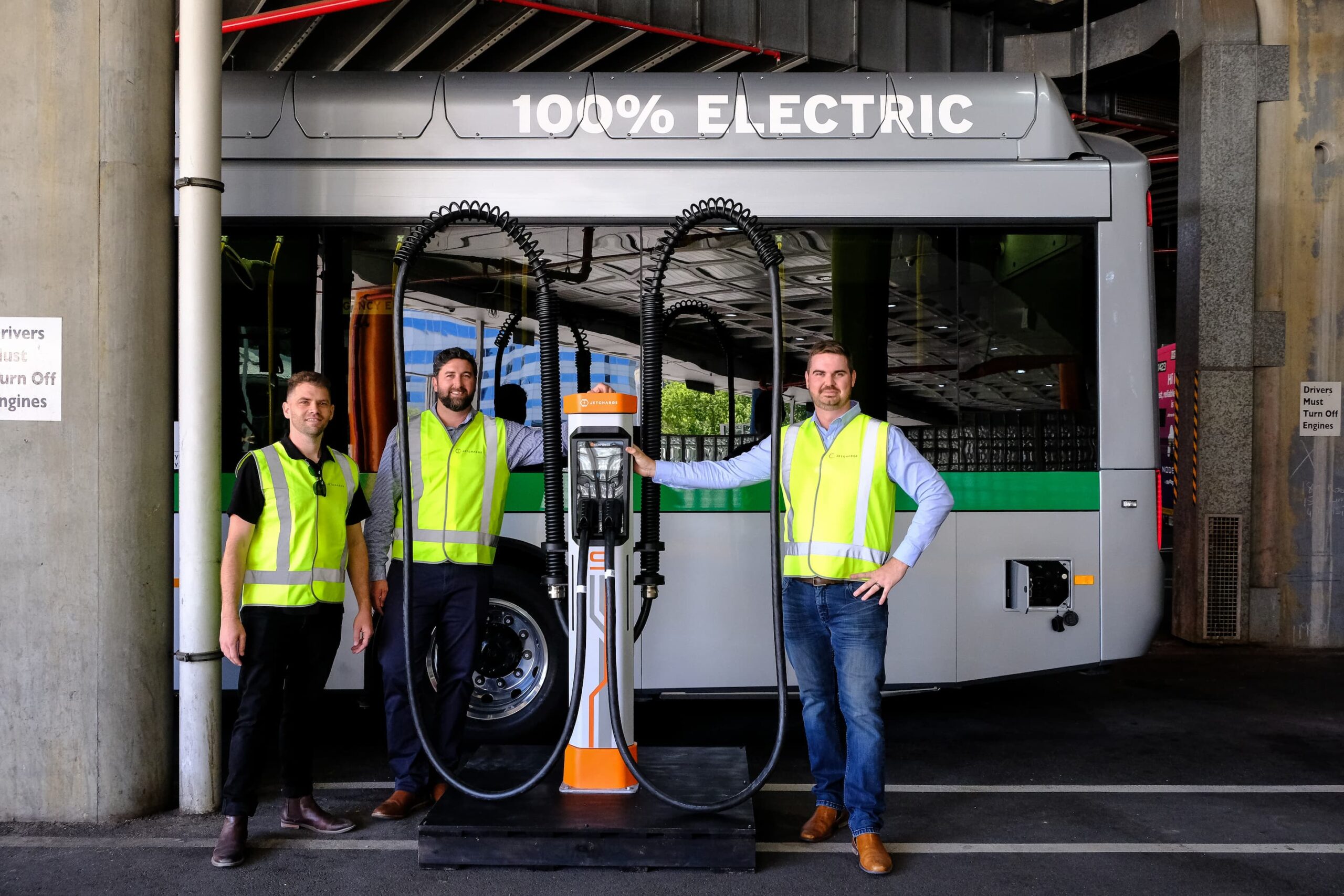
Proven at scale in
Western Australia


Sources
- Australian Government Department of Climate Change, Energy, the Environment and Water, “DRIVEN Program”, updated 27 May 2026.
- business.gov.au, “DRIVEN Charger Grant Stream” (2026 grant opportunity).
- Australian Government, “Driving the Nation Fund”, updated 27 May 2026.
- JET Charge, “The DRIVEN Charger Rebate Stream” (current dealership offering and application support information).